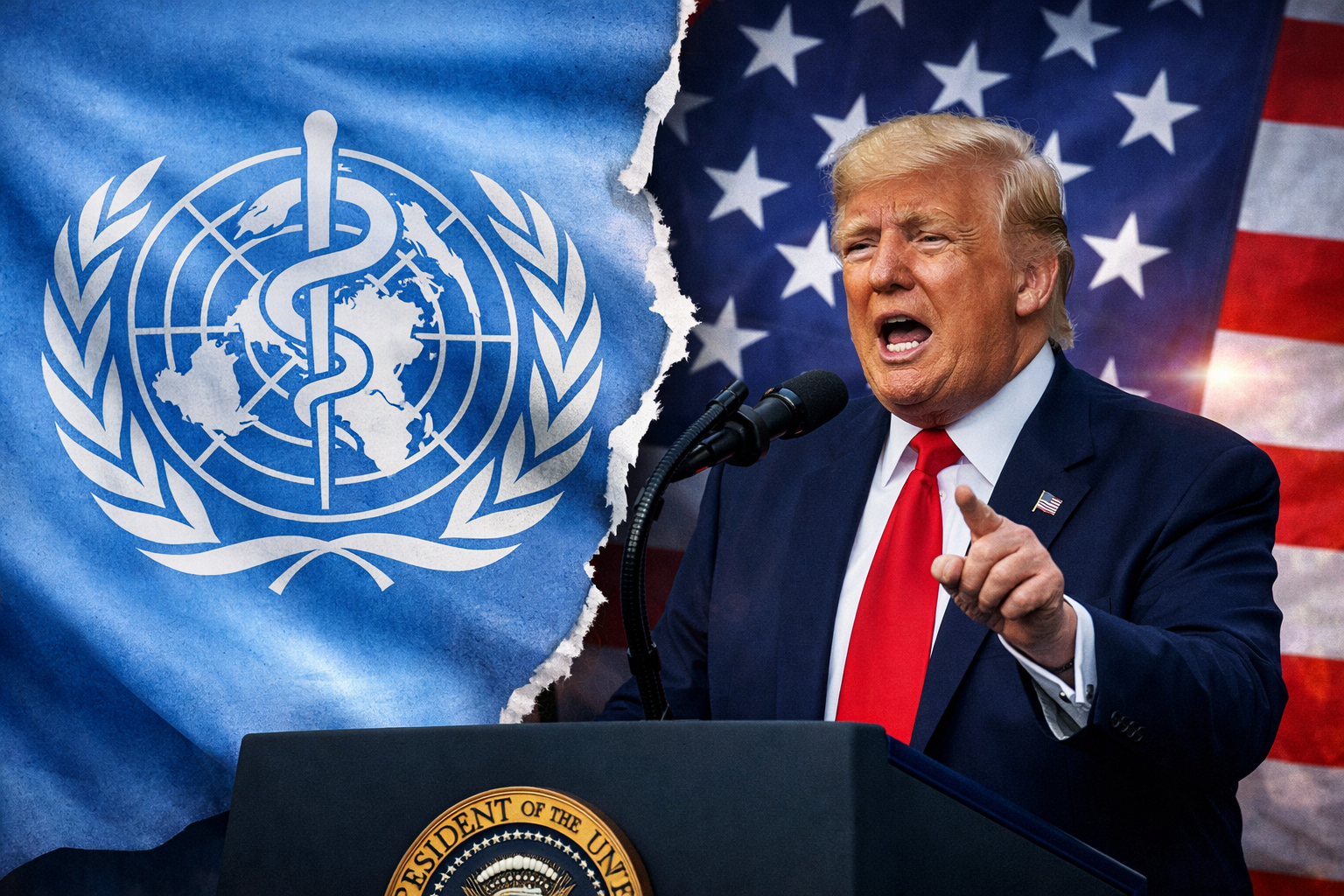
The US withdrawal from WHO has moved from a political signal to a concrete macro-risk variable for investors. The United Nations has said the U.S. exit is scheduled for January 22, 2026, following formal notification of intent delivered in January 2025.
While the market impact is not likely to show up as a single “event day” shock, the withdrawal matters because it weakens a central piece of global crisis infrastructure. It also shifts influence inside multilateral institutions, with potential spillovers into supply chains, emerging-market stability, and future crisis coordination.
Why Financial Markets Should Care
The WHO is not only a health body; it is part of the global early-warning and coordination layer that reduces the probability that localized outbreaks become global disruptions. Before the withdrawal process began, the U.S. was WHO’s top donor. WHO reports U.S. contributions of $1.284 billion in the 2022–2023 biennium.
That scale matters because global surveillance, rapid-response coordination, and technical assistance are not easily replaced with ad hoc bilateral programs. When that capacity is reduced, the distribution of outcomes shifts: fewer small, contained events; more scenarios where delays compound. For investors, that is a classic tail-risk setup.
Funding Shock and Operational Retrenchment
Even though formal exit timing follows a notice period, the funding signal hits immediately. Reporting tied to Reuters indicated the WHO began implementing cost controls in response to the U.S. withdrawal plan and the expected loss of support.
This is where global health funding becomes a macro input. Budget stress can translate into fewer technical missions, slower information flows, and reduced field presence in higher-risk geographies. That is not a linear problem: the damage from one delayed detection or fragmented response can exceed the savings from years of routine operations.
Legal and Process Uncertainty Raises “Execution Risk”
There is also an underappreciated near-term market factor: ambiguity around whether withdrawal conditions are fully satisfied. U.S. participation in WHO has been tied to a one-year notice requirement and the expectation that financial obligations be met, and analysts and policy observers have highlighted arrears-related complications.
For investors, this creates “execution risk.” Even if the intended exit date arrives, disputes over dues, status, or continued cooperation channels can produce a prolonged transition period. That prolongs uncertainty around how global surveillance and emergency coordination will function, especially in regions where WHO plays an outsized operational role.
Emerging Markets: Higher Vulnerability and Higher Dispersion
The most direct macro exposure concentrates in emerging markets, particularly lower-income and frontier economies with limited public health capacity and narrow fiscal buffers. Reduced multilateral support increases vulnerability to outbreaks that disrupt labor availability, domestic mobility, and trade.
This matters for sovereign risk through three channels:
- Fiscal shocks: emergency spending rises while revenues weaken.
- External balance stress: import needs (medical supplies) rise as tourism and trade flows fall.
- Financing conditions: risk premia widen if investors expect repeated shocks or slower recoveries.
In practical terms, this can show up as higher FX volatility, wider spreads, and higher dispersion within EM baskets, especially where political capacity to respond is weak.
Geopolitical Spillovers: Influence and Standards
The withdrawal also changes governance dynamics. A reduced U.S. role inside WHO can shift agenda-setting and norms, data sharing, transparency expectations, and emergency-response protocols. Over time, this can affect how quickly information is published and how coordinated responses are.
For markets, the transmission mechanism is indirect but real: weaker coordination increases the likelihood of trade frictions, unilateral restrictions, and inconsistent standards during crises. Those are the conditions under which supply chain risk rises, particularly for healthcare inputs, food supply chains, and export manufacturing hubs.